I trust that the reader will not take umbrage with the following observation: it’s not easy making a movie. It is surely harder to make a great movie. Hardest of all, it seems, is making a great Star Wars movie. George Lucas himself was only semi-successful. By my count, two are great Star Wars, two are good, two are okay, and two are bad. I’ll let you figure out where they all fall with the hint that Rogue One sits squarely in the “Okay” category. You can watch the theatrical cut on Netflix or, if you don’t want to waste a whopping 133 minutes, you can watch my version which is just under 90.
Which brings us to Lessons from the Edit: a new series in which I’ll discuss and present my re-cut version of a blockbuster film. First up: Rogue One: A Star Wars Story.
There are plenty of videos breaking down what doesn’t work in the first Star Warsanthology movie, so let’s quickly discuss the few positive aspects:
1. Visuals/Production. I believe Rogue One is the best looking Star Wars film since The Empire Strikes Back and it’s the one area where Rogue One outdid The Force Awakens. J.J. Abrams, like Joss Whedon, feels like a very good TV director but not a great film director. Because of this, many scenes in TFA actually looked a lot like Firefly to me. There was clearly thought and detail put into the production, but everything was a bit clean and a bit cheap. In Rogue One, however, the locations feel expansive and lived-in. The cinematography is rich and textured.
2. The Climax (Battle of Scarif). In Return of the Jedi, Han Solo spends most of the film’s climax trying to hotwire a door. He’s standing. In the same spot. For like half an hour. Legendary actor Harrison Ford has nothing to do. Rogue One manages to give each character a real task to complete (before they meet their unnecessary demise). Unfortunately, “completing the mission” is the only real motivation for most of the characters.
Which brings us to all the bad stuff.
The theatrical cut of Rogue One, much like Interstellar and many other current blockbusters, is long, tedious, and noisy. The characters are bland and can’t connect with the audience or each other; the tone is jarringly inconsistent; fan-service and re-shoots chop up the narrative and prevent cohesion.
Star Wars: A New Hope provides a great example of tight narrative construction. Generally speaking, new information, characters, and plot points are not presented to the audience until they are also presented to the film’s protagonist. We see and experience the movie through Luke Skywalker’s boyish eyes.
Rogue One, on the other hand, opens with an introduction to our protagonist as a young girl and then, after fast-forwarding 15 years during the film’s title card, jumps around from character to character, plot-point to plot-point, until the ensemble finally comes together in the end of the first act. They bicker and butt heads through the second act but by then end of the film we’re meant to believe they’re a team that cares about each other.
And then they all die. And then a CGI Princess Leia says “Hope” which is meant to make you forget that the ending of this movie is actually a total downer.
Rogue One should be a small movie about a band of rebels who attempt a daring mission that alters the course of the star war. But they insisted on shoving Darth Vader into the movie. And they insisted on shoving Uncanny Valley Tarkin into the movie. They tried to modernize the narrative with morally and politically ambiguous characters. It’s too many things, most of them bad.
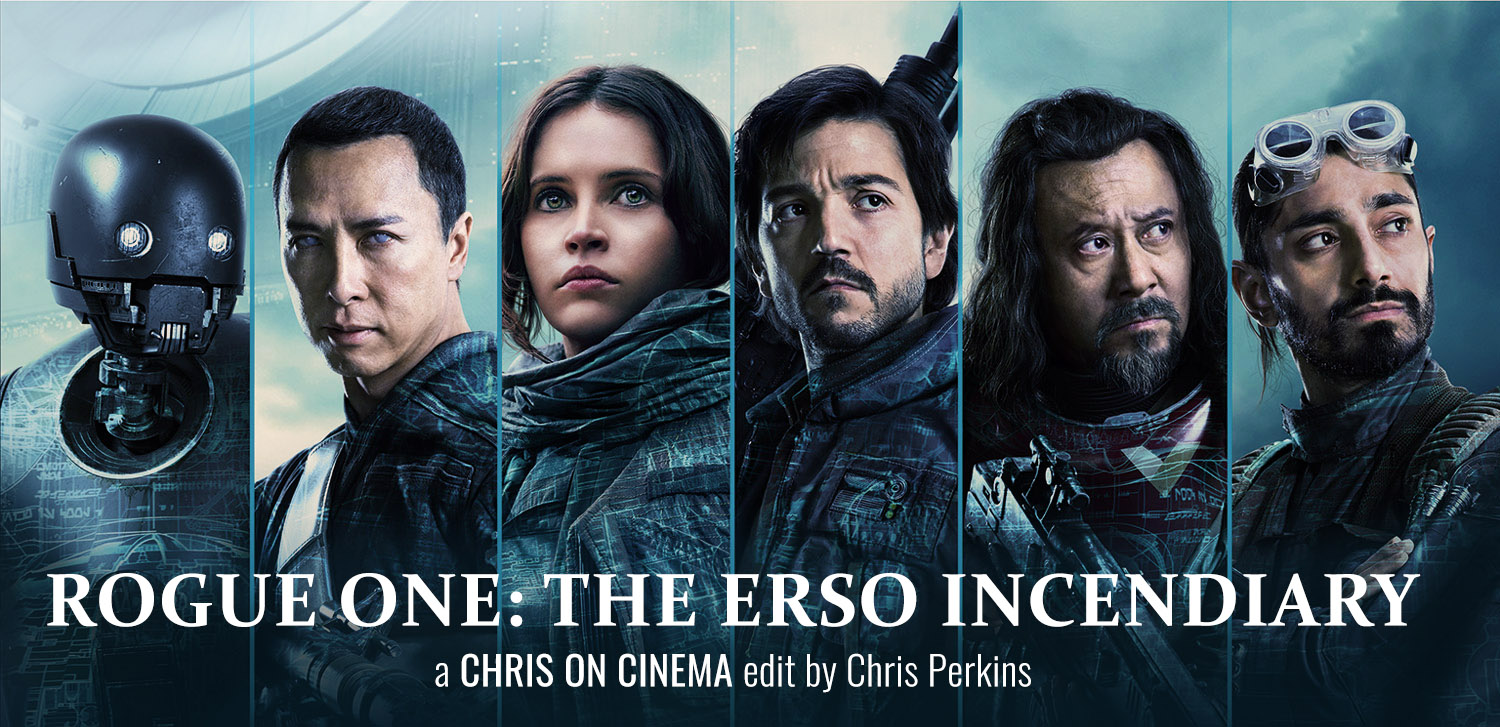
My intent for Rogue One: The Erso Incendiary was to refocus the story on Jyn’s journey. Therefore, most of the cross-cutting has been completely removed from the story. Director Krennick’s storyline is uninteresting, CGI Tarkin is distracting, and the few scenes with Darth Vader are unnecessary fan service. By allowing more of the film’s runtime to center on the Rebels, it was my hope that they’d feel like more of a team (though they remain pretty bland and, in some cases, are miscast). The entire film has been lightly recolored to warm up the rather bland desaturation. Finally, the ending of the movie has changed significantly. I don’t believe every main character needs to be dead by the time the credits role. By ending a few scenes on a more ambiguous note, the audience is free to imagine what happens to a character when the movie is over. That is, if a character doesn’t have an onscreen death, I don’t believe they needed to die.
Supplemental notes:
1. I’ve added a title crawl not because I think the film needs one to feel Star Wars-y but to highlight plot points that may be hard to follow given the scenes I took out. It looks pretty terrible because I didn’t spend a lot of time on it but it gets the point across.
2. There are lots of small changes and rearrangements in this edit that I simply can’t describe in a written post. I’m considering recording a commentary track to go into detail about my views on the theatrical cut and the changes I’ve made to it. Sound off if that’s something you’d be interested in listening to and let me know what other movies you’d be like to see on this series.
NOTE: You need to have one of Dropbox’s paid accounts to stream more than the first hour of the video but you should be able to download the video in its entirety. I’m currently trying to find a better streaming platform.
Next time on Lessons from the Edit: Man of Steel
Before you download “Rogue One: The Erso Incendiary,” please give Disney a hand and pay for a copy of the original film. “Rogue One: A Star Wars Story” is a Lucasfilm Ltd. production, directed by Gareth Edwards, with music by Michael Giacchino and John Williams.
Chris Perkins is a writer, designer, and filmmaker from Michigan with a master's degree in architecture from the University of Detroit Mercy.
Twitter: @chrison_
View all posts by Chris Perkins

 CHRIS ON CINEMA