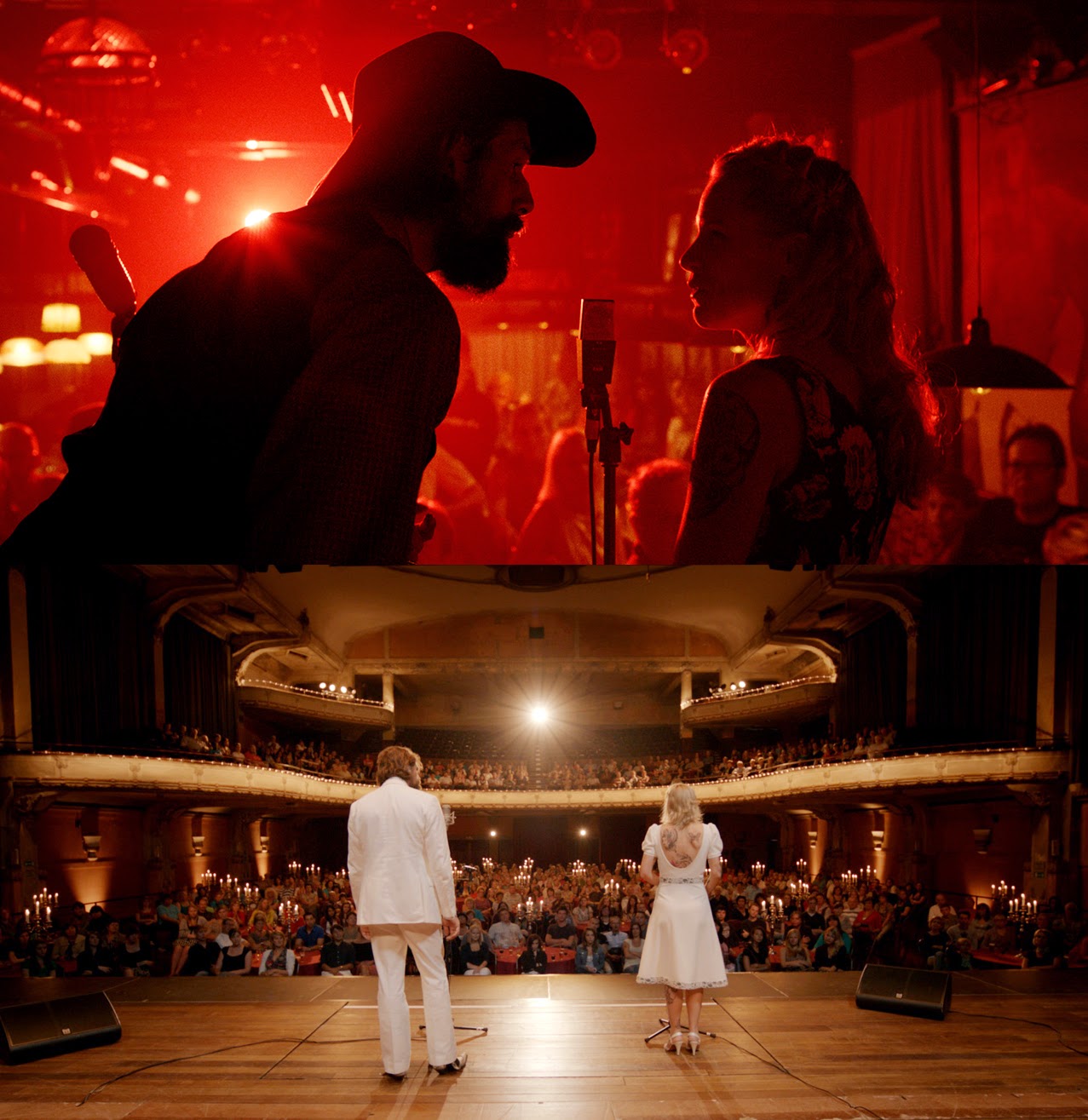
“Time is a flat circle.” The infamous phrase courtesy of Matthew McConaughey’s nihilistic Rust Cohle in HBO’s True Detective, like the show itself, failed to resonate with audiences as anything more than pop-culture fodder. Cohle’s metaphysical musing find a fitting (and much more engaging) partner in Felix Van Groeningen’s Oscar-nominated film The Broken Circle Breakdown. Compelling, warm, and textured, the film is everything True Detective was not—and then some.
“Will the circle be unbroken/By and by, by and by/Is a better home awaiting/In the sky, in the sky?” The musical number that opens Goeningen’s Bluegrass-marriage drama sets the scene both sonically and thematically for all of the aptly-titled film. Sliding back and forth through time we meet Didier (Johan Heldenbergh): a passionate Bluegrass musician who dreams of America—the land of second chances—and his lover Elise (Veerle Baetens): a free-spirited tattoo artist who boldly tells her life-story through the ink in her skin. We see them court, fall in love, get married, have a kid, suffer losses, and fall out of love. Though never in that exact order.
Beautiful, bittersweet, and melodic though it may be, the cross critics (perhaps unappreciative of the many Bluegrass interludes in the film) could easily point out some of Breakdown’s more glaring contradictions. Didier romantically describes America as the place where anyone can find a second chance yet we quickly find that he does not really believe in second chances at all. Didier believes life is one singular chance and for that reason you must fight for what you have and what you love. If any character should be waxing about second chances it is Elise. She lives with an air of impulsive impermanence. Quickly covering her body in the names of her lovers only to cover them up if it doesn’t work out. Anything can be covered up and changed. One can always move on. The understanding viewer will surely see these contradictions as part of what make these characters seem so fully human.
Many parallels can be drawn to Derek Cianfrance’s 2010 filmBlue Valentine starring Ryan Gosling and Michelle Williams. Bluegrass and Belgian setting aside, the two movies tell a similar story in a similar way. Yet somehow Heldenbergh and Baetens make Breakdown feel larger. Sure, there is more spectacle, more mysticism in Groeningen’s direction but that isn’t all. Baetens (who won multiple awards for her chameleonic performance) would outshine both Gosling and Williams combined who, in comparison, seem more like children acting out than complex adults. Even if that is only a result of the darker subject matter that Breakdown occasionally reaches for through its unchronological conquest.
In many ways, Breakdown answers its own question regarding the fateful circle. Afterall, the film is not called “The Circle” or “Will The Circle Be Unbroken?” We are aware from the outset that things will indeed fall apart. The nonsequential narrative structure only emphasizes this. Yet the film never feels like Rust Cohle’s existential funeral dirge of Time as a flat circle. Rather, we find that the circle urges us to press forward. Even when the stage is too large and the performance no longer feels intimate, the song must play on. In this way, the much less pessimistic words of Walt Whitman’s Leaves of Grass come to mind: “All goes onward and outward, nothing collapses, And to die is different from what any one supposed, and luckier.”
An American dream if there ever was one. Didier would approve—as long as the leaves of grass are blue.
 CHRIS ON CINEMA