Bright Eyes, Dim Wit: Richard Linklater’s “Boyhood”

“When I was a child, I spoke and thought and reasoned as a child. When I grew up I put away childish things.”
                                                                                                                                
                                                                                                                                 -1 Corinthians 13:11
Imagine your neighbors invite you over to watch their home movies. Politely, you will agree to spend a few hours as a spectator of the lives of people you recognize but do not know. Like all home movies, theirs will begin with milestones—birthdays, holidays, weddings, etc.—but will meander and devolve until you’re only watching Uncle Frank’s shoes because he forgot he was holding the camcorder. Add some clunky, unnatural dialogue and you have Richard Linklater’s Boyhood: a film with a powerful, intriguing concept that ultimately fails in its execution.

For those unfamiliar, Boyhood is a coming-of-age story that was shot intermittently over 12 years with the same cast. I entered the movie theater to see Boyhood with high hopes but low expectations. Initially, I was charmed by the “period” soundtrack, the late-90s paraphernalia, and the bright-eyed Mason Jr. (Ellar Coltrane).  Boyhood, as many have described, is like a time capsule. It is fun, at first, to dredge up the objects and images that once defined us. In this way, Linklater does an impressive job of revealing Mason as he grows. At the start of each implied vignette we begin to notice the small changes in appearance that mark growth and age. It is important to note that these moments are the most subtle and also most effective portions of the entire film (and that they would occur simply by the nature of the concept, regardless of the director).
Unfortunately, the rest of Boyhood’s near 3-hour running time is uncomfortable and, worse, uninteresting. As Mason and his sister Samantha grow, their kid-acting becomes less endearing and more distracting. Even less forgivable is their mother, played by Patricia Arquette, who always seems to be reading from a script like an unprepared host on SNL. In fact, all of the dialogue feels like an over-written recitation from the actors and an under-written anti-statement from Linklater.
Characters struggle to guide and advise Mason through his formative years with clichés and rambling diatribes that amount to little. Mason himself grows into a vapid, philosophizing teen which is only slightly more excusable. After all, it is the teenage rite to believe one is smarter and more aware than everyone else. Yet this doesn’t seem to be a theme Linklater is trying to point out; it is merely something he stumbled upon that, like Uncle Frank’s shoes, happened to end up on film.
This is perhaps the greatest summation one can make of Boyhood: it strives for naturalism but is only vacuous. Intentionally or not, it says very little. In this way, it is less of a time-capsule and more of a Rorschach test. Anything one pulls out of the film is only a projection that the film itself, vaguely shaped as it is, did not put in.   

One might argue that all of this is intentional. Matt Zoller Seitz argues, “the movie’s constant (if empathetic) critique of American manhood, or what passes for American manhood: an entitled mental state that is really just boyhood with money and a driver’s license.” This would be an acceptable explanation if the film centered on Ethan Hawke’s Mason Sr. (which would have been a good idea considering his is the only performance that feels natural, watchable, and seems to have a purpose) who enters the film as a displaced ex-husband, caring-but-distant dad, and clichéd man-boy.
It is true that Mason Jr. is devoid of passion, drive, and intelligence (not to mention personality). But the film is not perceptive or intuitive enough to make this interesting let alone a critique and thus, at best, it is the theme. If this is true then Boyhood is not the awe-inspiring, brilliant film that the trailer, poster, and (worst of all) critics have suggested but it is the most nihilistic, negative picture of the American, male condition in recent memory. This also seems far too extreme for Linklater’s tonally neutral production.

If every director has one goal it should be to make an engaging film. Not every film has to have a grand 
message, make a statement, be interesting or devoid of boring moments but if a movie does not engage its audience then what is the point?
Derek Cianfrance’s Blue Valentine and The Place Beyond the Pines tell the story of a failing marriage and father-son relationships, respectively, in a way that is affecting and interesting. The characters feel real and 3-dimensional while the story is grounded with an actual purpose. In a much less naturalistic way, Terrence Malick’s The Tree of Life, which actually deserves accolades like “Brilliant” and “Awe-Inspiring,“ evokes the wonder of being a child and the anxiety that comes with growing up.

None of the characters in The Tree of Life are very interesting but the film is immersive because of the atmosphere it creates. The actors don’t seem to be reciting lines, they’re simply exploring the world that Malick built for them. The opposite is true in Boyhood. Only Linklater himself seems to be alive: he is making mistakes, improvising, and taking risks while his characters only coast.
 Matt Zoller Seitz says, “Every character [in Boyhood] has a least one moment in which they have to heed the advice of Corinthians and put away childish things. None of them like it.” Perhaps Linklater needed to heed that advice as well. It is easy to get tunnel-vision working on a creative project. It is easy to fall in love with a concept and believe that it will automatically translate into a powerful final product. It is hard to put away these childish notions. It is harder to watch a long, pointless film full of unlikable characters. If your neighbors ask you to watch their home movies, consider reading a book instead. If they ask you to watch Boyhood, know that it is an important film—not for what it is but for everything it isn’t. 
Streetlights and Soliloquies: Steven Knight’s “Locke”

Built for efficiency but dressed as luxury, the car is a dichotomous condition. Within the womblike interior of rounded edges, soft lines, and climate control, we are warned to govern the growling, sputtering death machine that could end a life without a seatbelt or sobriety. All of this is of little concern to Ivan Locke—the titular character in Steven Knight’s Locke—yet it proves the film’s main point: a carefully controlled environment—a car or a life—is no match for the inevitable but unexpected complications of life.

 [Some minor spoilers ahead]
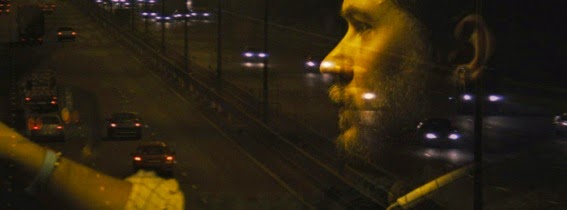
When we meet Ivan Locke (played by Tom Hardy sporting a stylish beard and Welsh accent) he is entering his car at the end of a work day and the movie ends before he leaves it. This is Locke’s main conceit: the only location is Locke’s BMW, the only face we see is Hardy’s. It is a (literally) theatrical experiment on the part of Knight and the effortlessly versatile Hardy that is immensely satisfying to behold.

Locke is a construction foreman and a careful man. He obeys the speed limit and is precise in his work. Yet as he drives across town before the birth of his child, phone-call by phone-call, his life begins to unravel. Watching Tom Hardy act opposite abstract voices it is almost tragic to recall The Dark Knight Rises in which nearly all of his expressive face was masked. It is unlikely that Hardy will win any awards for this performance if only because of how effortless it seems. Through heated calls and Shakespearean monologues, Locke’s voice, and Hardy’s prowess, is unwavering.
And yet, tense and flawlessly executed as Knight’s film is, something seems missing. Some might call it an intentional anticlimax but the problem with filming with such a specific, heightened structure (think Nolan’s Memento which takes place in reverse chronological order) when the lights come up that’s all you have.

Like a pregnancy complication that can change an umbilical cord from a lifeline to a noose, the problem with such a self-contained format, regardless of how flawlessly executed, is it is always simultaneously safe and constricting. A dichotomous condition indeed.

Shadows in the Valley: A Roger Deakins Supercut

Roger Ebert once said that to simply watch the visuals of a Martin Scorsese film would be just as effective as the experience of the standard audio/visual combination. The same could be said of any film shot by master cinematographer Roger Deakins. From the white-washed landscapes in Fargo to the dazzling palette of Skyfall, few of contemporary cinema’s most iconic shots would exist were it not for Deakins. Enjoy, as I did, this supercut of some of his best work (after the break, courtesy of Plot Point Productions) and stay tuned for my review of Steven Knight’s Locke coming soon!

Counterpoints and Condescension: on Michael Bay’s “Transformers: Age of Extinction”

I respect Michael Bay as a filmmaker and I’m intrigued by how defiant it feels to make that statement. I went into my friendly, neighborhood multiplex with an open mind to see Transformers: Age of Extinctionand I was pleasantly surprised with what I found. While undoubtedly flawed, Bay’s new Hasbro cash-grab is the best of the franchise, improving on the previous Transformers movies in almost every way.

Age of Extinction replaces Shia LaBeouf and his whiny teen-drama storyline with Mark Wahlberg and a melodramatic father-daughter storyline. Right off the bat, I have to commend Bay for completely disregarding LaBeouf’s Sam Witwicky—providing not even an allusion to the character’s existence. I only wish we could all do the same with the actual Shia LaBeouf. Beyond that, all you need to know about the plot is that this is a Transformers movie.
Actually, that’s all you need to have in mind the entire time and you’ll be fine. Is there cheesy, clunky, expositional dialogue? Yes. Is the first act slow-moving and full of “jokes” that audiences won’t laugh at unless their friendly, neighborhood multiplex serves alcohol? Of course. Yet through the din there is an inkling of maturation in Bay’s direction.

As the longest Transformers movie to date, Age of Extinctioncould certainly use another pass in the editing room but it also boasts the most succinct, straightforward storyline, the cleanest action, and the least misogyny and awkward innuendos of all its predecessors. I predict that by Transformers 6 we might actually have a fully coherent movie. Unless he decides to backpedal into his more familiar mayhem.
Writing for Collider.com, Matt Goldberg proclaimed Bay’s films are “not for people who watch movies for a living; they’re for people who want to ‘turn off their brains.’” In his condescension (presumably while listening exclusively to classical music), Goldberg forgets that there are as many types of movies as there are people to view them. Some films are meant to be immersive and some are meant to be escapist but both have the potential to be fulfilling or pointless. Jonathon Glazer’s critically hailed Under the Skintries very hard to be immersive but I found it even less engaging than Age of Extinction.

Glenn Kenny, writing for RogerEbert.com, referred to Age of Extinction as “infantile.” No arguments there but have we forgotten this franchise is based on (and produced by the makers of) a series of plastic toys? I praise its infantile nature. Finally we have a Transformers movie that isn’t so full of F-bombs and gratuitous sexiness you’d be embarrassed to watch it with your children.
Age of Extinction features Optimus Prime riding a robotic t-rex, carrying a flaming sword and squaring off against a Transformer that turns into a Lamborghini and has a gun that comes out of his face. HIS FACE. Take a moment to let that sink in and I dare you to tell me the idea doesn’t delight you. If you can take a step back and appreciate Bay’s film for what it is, then it is an utterly rewarding ride.

Glenn Kenny ended his review with this quote from the New Testament’s Book of Corinthians: “When I was a child, I spake as a child, I understood as a child, I thought as a child: but when I became a man, I put away childish things.” I’d like to counter with a quote from Matthew: “Truly, I say to you, unless you turn and become like children, you will never enter the kingdom of heaven.”
If you can’t revel in the colorful cacophony that is Age of Extinction then perhaps you can find something more fulfilling to do. Maybe light up a cigarette and enjoy a Broadway show.

Low Lifes: James Gray’s “The Immigrant”

January, 1921 is snowless but perpetually bleak in—I’m sorry, let me start over. James Gray’s The Immigrant would be this year’s winningest film for the religious Right were it not for all of the topless women. There. Do I have your attention? A story of desperation, tribulation, and salvation, Gray’s new film is full of pathos and careful camerawork but the whole never quite equals the sum of its parts.

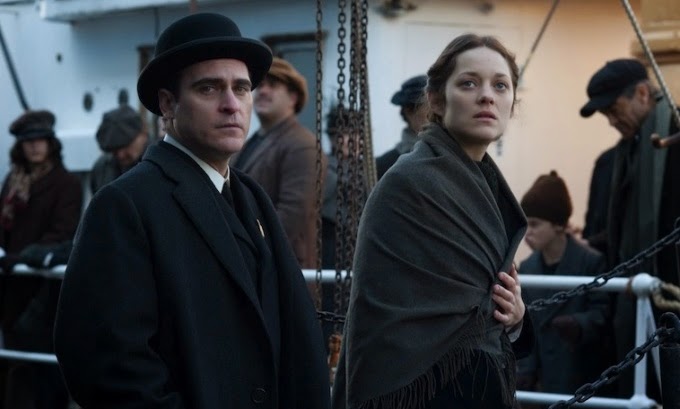
Despite some of its eventual fumbling, The Immigrant’s first act wastes no time getting the ball rolling. We meet Ewa (Marion Cotillard) and her sister Magda (Angela Sarafyan) as they first arrive on Ellis Island. The latter is quickly quarantined for possible lung disease while the former is flagged as a “woman of low morals” for an altercation on the ship to America. Luckily, the mysterious, brooding Bruno (Joaquin Phoenix) finds our damsel in distress and swoops in to save her. Brutish and manipulative though he is, Bruno gives Ewa a place to stay and thus she, with seemingly no other options, becomes indebted to him. And all that in only the first 10 minutes!

To help Ewa earn enough money to release Magda, Bruno lets her dance at his theater and work at his brothel which is conveniently located down the hall from his own apartment. Things get more complicated with the return of Bruno’s cousin Emil (Jeremy Renner), an idealistic magician who sets his sights on the pure-hearted Ewa much to Bruno’s chagrin.
The Immigrant’s strongest asset is undoubtedly the casting of the three leads. Who would have thought that Jeremy Renner, who played a cardboard cutout of the B-list Avenger, Hawkeye, would have such genuine on-screen chemistry with Marion Cotillard? Renner’s appearance in the second act of Gray’s film is a breath of fresh air after a rather paint-by-numbers opener.

Joaquin Phoenix is boorish as ever with his signature schizophrenic baritone swinging violently from whine to growl not unlike his character who, at any moment, may fall into a fit of rage or lend a compassionate hand to Ewa who he quickly (and predictably) falls in love with. Yet even Phoenix, an increasingly consistent actor who one almost assumes will steal any scene he’s in, is no match for the empathetic power of Marion Cotillard. In another life, Cotillard was surely a silent film star. An obvious inspiration for this role, which was written specifically for her, is Renee Jeanne Falconetti in Carl Dreyer’s The Passion of Joan of Arc. James Gray wisely allows the camera to linger on her large, emotive eyes. Work smart, not hard, as the saying goes.
Yet therein lies the problem. Though the narrative is almost exclusively set from Ewa’s point of view, the film, like the two-faced Bruno, never figures out what it wants to be. The aforementioned nudity and the original title of the film, Low Life, suggests a gritty realism that perhaps Gray or the studio didn’t feel comfortable going all the way with.

No two characters share a kiss, let alone a bed, in The Immigrant which is rather shocking considering this is a film about a reluctant prostitute (is that redundant?). Christopher Nolan, one of the few directors in Hollywood who seems completely uninterested in sex, even has a more provocative scene in The Dark Knight Rises with Cotillard and Christian Bale lounging in front of a fire. I’m no proponent for gratuitous, on-screen sex but for a film that tries so hard to illustrate the desperate measures of a desperate time in American history, Ewa’s implied actions carry almost no emotional weight.
Gray’s film could easily be compared to Tom Hooper’s messier but equally operatic Les Miserables. Stacked against each other, The Immigrantis undoubtedly a better film yet perhaps the best possible, hind-sighted scenario would have been to have Gray direct Les Miserables. Perhaps his more nuanced direction would led to more nuanced performances since the stories themselves are fairly similar: Christ-figures do no evil and characters inexplicably fall in love because that’s what characters are supposed to do! Joaquin Phoenix could even play Javert to save both Russell Crowe and the audience the embarrassment of hearing him sing. But I digress.

What we are left with is a film that dreams of being The Godfather or Steve McQueen’s 12 Years A Slave but is actually closer to a saccharine Spielberg morality tale. “There’s no art without risk,” Gray recently said in an interview, citing Francis Ford Coppola. If this is true, then The Immigrant is no work of art. If Gray had gone to Sunday school he’d know, as his film ponders, that it is not a sin to be a lowlife, only to be lukewarm.