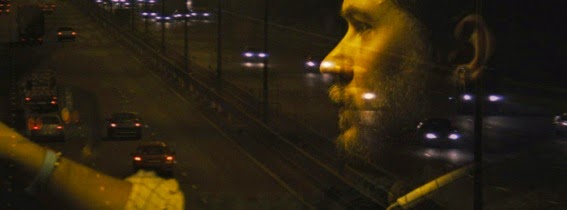
Built for efficiency but dressed as luxury, the car is a dichotomous condition. Within the womblike interior of rounded edges, soft lines, and climate control, we are warned to govern the growling, sputtering death machine that could end a life without a seatbelt or sobriety. All of this is of little concern to Ivan Locke—the titular character in Steven Knight’s Locke—yet it proves the film’s main point: a carefully controlled environment—a car or a life—is no match for the inevitable but unexpected complications of life.
[Some minor spoilers ahead]
When we meet Ivan Locke (played by Tom Hardy sporting a stylish beard and Welsh accent) he is entering his car at the end of a work day and the movie ends before he leaves it. This is Locke’s main conceit: the only location is Locke’s BMW, the only face we see is Hardy’s. It is a (literally) theatrical experiment on the part of Knight and the effortlessly versatile Hardy that is immensely satisfying to behold.
Locke is a construction foreman and a careful man. He obeys the speed limit and is precise in his work. Yet as he drives across town before the birth of his child, phone-call by phone-call, his life begins to unravel. Watching Tom Hardy act opposite abstract voices it is almost tragic to recall The Dark Knight Rises in which nearly all of his expressive face was masked. It is unlikely that Hardy will win any awards for this performance if only because of how effortless it seems. Through heated calls and Shakespearean monologues, Locke’s voice, and Hardy’s prowess, is unwavering.
And yet, tense and flawlessly executed as Knight’s film is, something seems missing. Some might call it an intentional anticlimax but the problem with filming with such a specific, heightened structure (think Nolan’s Memento which takes place in reverse chronological order) when the lights come up that’s all you have.
Like a pregnancy complication that can change an umbilical cord from a lifeline to a noose, the problem with such a self-contained format, regardless of how flawlessly executed, is it is always simultaneously safe and constricting. A dichotomous condition indeed.
 CHRIS ON CINEMA