January, 1921 is snowless but perpetually bleak in—I’m sorry, let me start over. James Gray’s The Immigrant would be this year’s winningest film for the religious Right were it not for all of the topless women. There. Do I have your attention? A story of desperation, tribulation, and salvation, Gray’s new film is full of pathos and careful camerawork but the whole never quite equals the sum of its parts.
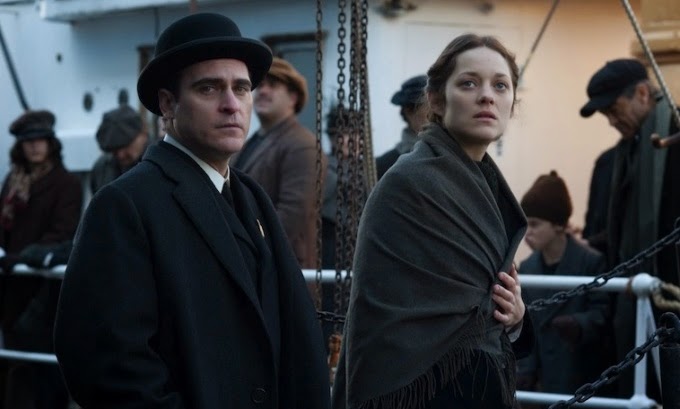
Despite some of its eventual fumbling, The Immigrant’s first act wastes no time getting the ball rolling. We meet Ewa (Marion Cotillard) and her sister Magda (Angela Sarafyan) as they first arrive on Ellis Island. The latter is quickly quarantined for possible lung disease while the former is flagged as a “woman of low morals” for an altercation on the ship to America. Luckily, the mysterious, brooding Bruno (Joaquin Phoenix) finds our damsel in distress and swoops in to save her. Brutish and manipulative though he is, Bruno gives Ewa a place to stay and thus she, with seemingly no other options, becomes indebted to him. And all that in only the first 10 minutes!
To help Ewa earn enough money to release Magda, Bruno lets her dance at his theater and work at his brothel which is conveniently located down the hall from his own apartment. Things get more complicated with the return of Bruno’s cousin Emil (Jeremy Renner), an idealistic magician who sets his sights on the pure-hearted Ewa much to Bruno’s chagrin.
The Immigrant’s strongest asset is undoubtedly the casting of the three leads. Who would have thought that Jeremy Renner, who played a cardboard cutout of the B-list Avenger, Hawkeye, would have such genuine on-screen chemistry with Marion Cotillard? Renner’s appearance in the second act of Gray’s film is a breath of fresh air after a rather paint-by-numbers opener.
Joaquin Phoenix is boorish as ever with his signature schizophrenic baritone swinging violently from whine to growl not unlike his character who, at any moment, may fall into a fit of rage or lend a compassionate hand to Ewa who he quickly (and predictably) falls in love with. Yet even Phoenix, an increasingly consistent actor who one almost assumes will steal any scene he’s in, is no match for the empathetic power of Marion Cotillard. In another life, Cotillard was surely a silent film star. An obvious inspiration for this role, which was written specifically for her, is Renee Jeanne Falconetti in Carl Dreyer’s The Passion of Joan of Arc. James Gray wisely allows the camera to linger on her large, emotive eyes. Work smart, not hard, as the saying goes.
Yet therein lies the problem. Though the narrative is almost exclusively set from Ewa’s point of view, the film, like the two-faced Bruno, never figures out what it wants to be. The aforementioned nudity and the original title of the film, Low Life, suggests a gritty realism that perhaps Gray or the studio didn’t feel comfortable going all the way with.
No two characters share a kiss, let alone a bed, in The Immigrant which is rather shocking considering this is a film about a reluctant prostitute (is that redundant?). Christopher Nolan, one of the few directors in Hollywood who seems completely uninterested in sex, even has a more provocative scene in The Dark Knight Rises with Cotillard and Christian Bale lounging in front of a fire. I’m no proponent for gratuitous, on-screen sex but for a film that tries so hard to illustrate the desperate measures of a desperate time in American history, Ewa’s implied actions carry almost no emotional weight.
Gray’s film could easily be compared to Tom Hooper’s messier but equally operatic Les Miserables. Stacked against each other, The Immigrantis undoubtedly a better film yet perhaps the best possible, hind-sighted scenario would have been to have Gray direct Les Miserables. Perhaps his more nuanced direction would led to more nuanced performances since the stories themselves are fairly similar: Christ-figures do no evil and characters inexplicably fall in love because that’s what characters are supposed to do! Joaquin Phoenix could even play Javert to save both Russell Crowe and the audience the embarrassment of hearing him sing. But I digress.
What we are left with is a film that dreams of being The Godfather or Steve McQueen’s 12 Years A Slave but is actually closer to a saccharine Spielberg morality tale. “There’s no art without risk,” Gray recently said in an interview, citing Francis Ford Coppola. If this is true, then The Immigrant is no work of art. If Gray had gone to Sunday school he’d know, as his film ponders, that it is not a sin to be a lowlife, only to be lukewarm.
 CHRIS ON CINEMA